Gender equality

Women are more likely to attain tertiary education than men in all Nordic countries. Despite this educational advantage, men have higher gross hourly earnings than women on average. Differences in educational choices among men and women may serve as partial explanations for these wage differences. However, the wage gap is persistent within a broad range of economic sectors. Other potential confounding variables, such as specific job roles and years of experience are also likely to play a role. Nonetheless, the data establishes an overall trend where wage differences are favouring men across the Nordic labour market.
The Nordic gender equality indicators are a collection of 33 indicators selected to illustrate the Nordic region from a gender perspective. The indicators are cross-sectoral and span over the following topics: Demography, economy, family and care, health, income, influence and power, and labour market. Data for the Nordic gender equality indicators can be found here.
The landing page for the Nordic gender equality indicators at the Nordic Statistics website was recently updated with additional graphs and information, broadening the view to provide more insight into historic and current gender differences in the region. Feel free to visit the newly updated landing page for Gender equality here.
This article focuses on differences in educational attainment, educational choices and wages among men and women in the Nordic region.
Education
Women are more likely than men to attain tertiary education in all Nordic countries. In 2024, a higher percentage of women had attained tertiary education compared to men in all represented countries. The largest relative difference can be observed in Iceland by 20 percent. This is followed by Finland, Norway and Sweden that all register a difference by 14 percent. This can be compared with a difference of 5 percent between men and women in the EU. However, the tertiary educational attainment is lower in the EU for both men and women compared to most Nordic countries.
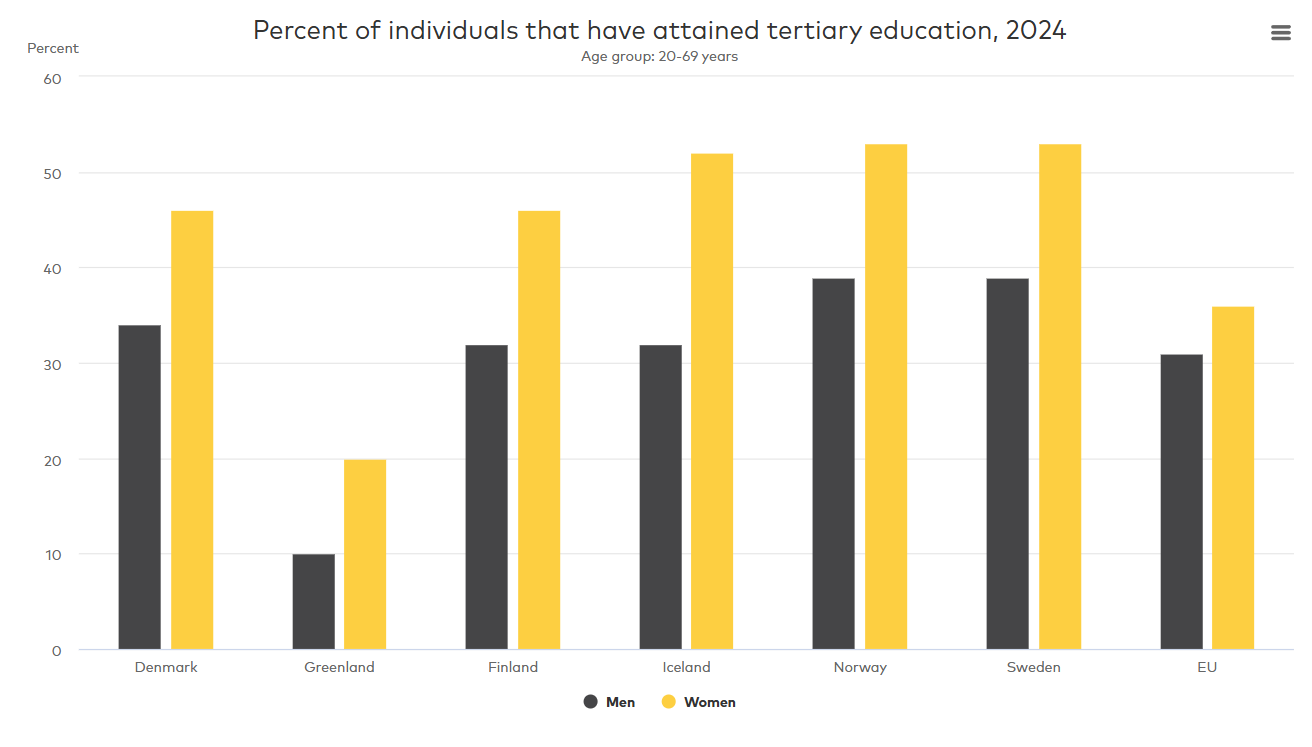
Source: EDUC11
Gender pay gap
While women are more likely to attain tertiary education than men, they earn less than men on average. This can be seen by using the gender pay gap measurement, which reflects differences in average gross hourly earnings of male and female employees. A gender pay gap above zero implies that men have higher gross hourly earnings than women.
The graph below displays the gender pay gap for ‘Total industry, construction and services’, which is an aggregate of 18 economic activities based on the NACE Rev.2 classification used in the EU. The gender pay gap can also be viewed for these economic activities separately.
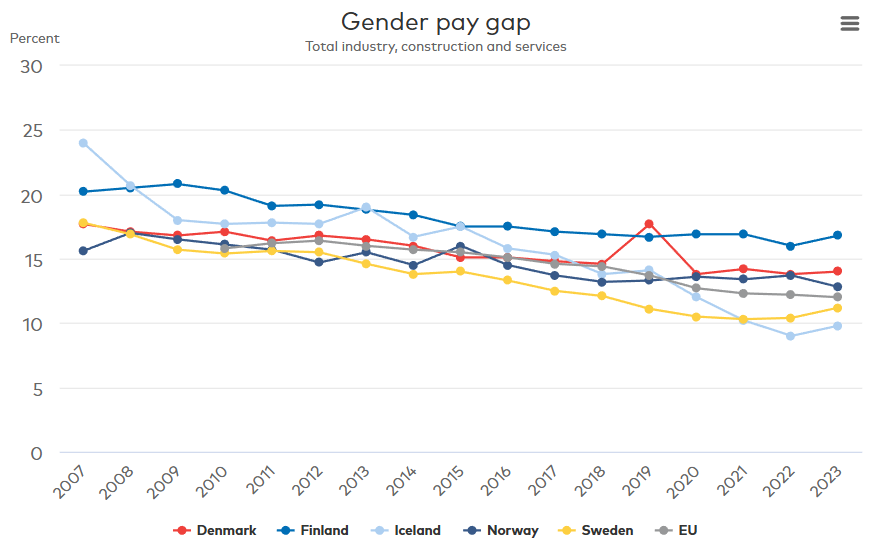
Source: INCO05
The pay gap between the genders has declined during the past 15 years, even though the gap was still evident in 2023. Interestingly, the lowest pay gap is reported in Iceland, which also reports the largest gender gap in terms of tertiary educational attainment.
Educational choices
One aspect that might partially explain the pay gap is the chosen fields of education among men and women. For example, women are more likely to choose studies within the fields of health and welfare services than men. Women are also more likely to choose study fields within social sciences, journalism and information. Men are however more likely to choose study fields within engineering, manufacturing and construction.
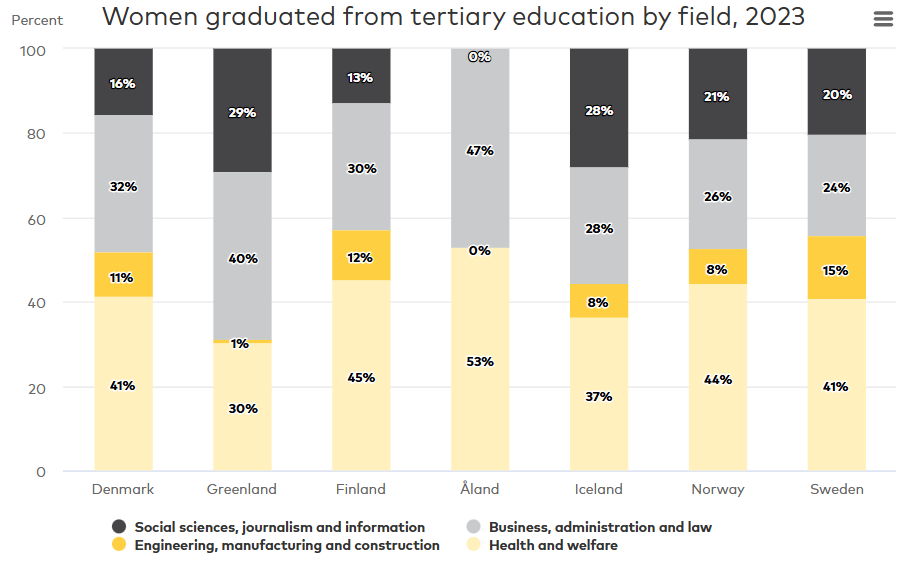
Source: EDUC09
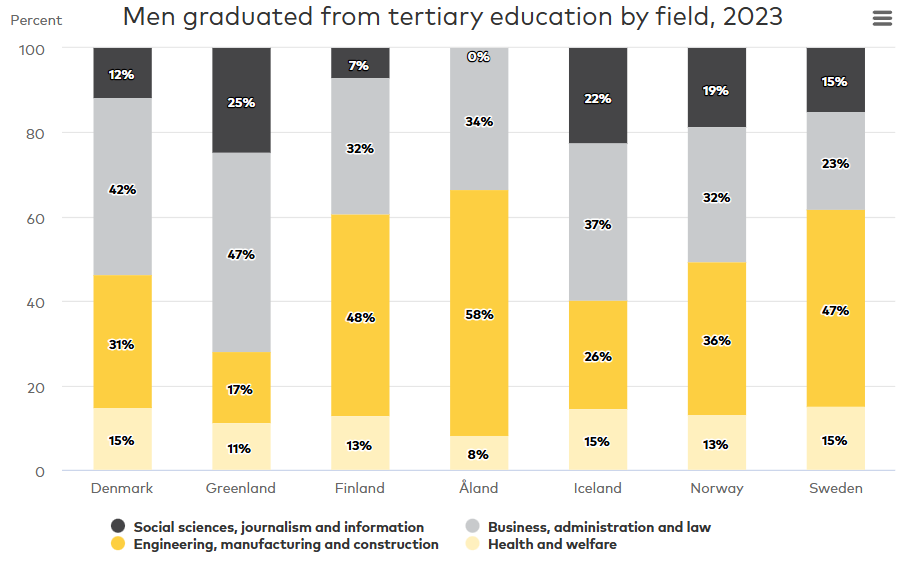
Source: EDUC09
Even though there are evident differences in chosen fields of studies among men and women - and subsequently differences in occupational choices - women are generally paid less for their work compared to men.
Gender pay gap by economic activity
As earlier mentioned, the gender pay gap can also be studied within various economic activities. In the graph below, the gender pay gap is presented for each of these activities in the Nordic countries in 2023. Click on the graph to expand it.

Source: INCO05
Even when comparing the wages within different economic sectors, the pay gap among men and women is persistent. In almost all sectors, men have higher gross hourly earnings than women on average. A few exceptions are seen. In ‘Water supply, sewerage, waste management and remediation activities’, women have higher earnings than men in all countries except Denmark. We can also see that women have higher earnings than men in the construction sector in Iceland.
Apart from a few exceptions, men’s earnings are higher across the board. The largest pay gap can be seen in financial and insurance activities, followed by wholesale and retail trade, repair of motor vehicles and motorcycles.
Even though these figures do not account for potential confounding variables such as specific job roles or experience, the data reveals a persistent trend. With few exceptions, a gender wage gap favouring men is evident across almost all economic sectors, with this gap being particularly pronounced in fields like finance and insurance.
For more data on gender equality in the Nordic region - for example life expectancy, parental leave and gender balances in the national parliaments – please visit the landing page for Gender equality here.