Integration and migration data update - significant rise in Ukrainian population across the Nordics

In December 2025, unique data on integration and migration in the Nordic region was updated with recent figures, revealing an increase in the foreign-born population across all Nordic countries. The number of foreign-born individuals from Europe - and Ukraine in particular - has risen substantially following Russia’s full-scale invasion in 2022. Since then, Denmark reports the largest absolute increase of Ukrainians (32,000 individuals), whereas Iceland reports the largest increase relative to population size, rising from 1.2 to 9.5 per 1,000 inhabitants.
The integration and migration statistics presented in this news article are the result of a co-operation project, involving Nordic Statistical Institutes, called Nordic comparative measures on migration and integration, financed by the Nordic Council of Ministers. The project has been ongoing since 2015, and the aim has been to harmonise immigration and integration statistics among the Nordic countries. The results of this new data offer insights into the demographic structure, labour market and education among foreign-born and their descendants.
Results were first presented in November 2018, and data was updated in the summer of 2024. The 2024 update included values for three additional years, expanded the list of countries, and included absolute values alongside percentages.
In December 2025, data on integration and migration in the Nordic region was updated once again. Delivery of recent population figures for Norway has been delayed and will be added in a future update.
Earlier articles on the Integration & migration can be found here:
New statistics on integration and migration in the Nordics
More on Nordic integration and migration - new report published
Integration and migration – A labour market perspective
Integration, migration and education
The landing page for Integration and migration at the Nordic statistics website can be found here, while the full database can be accessed here.
Foreign-born population in the Nordic countries
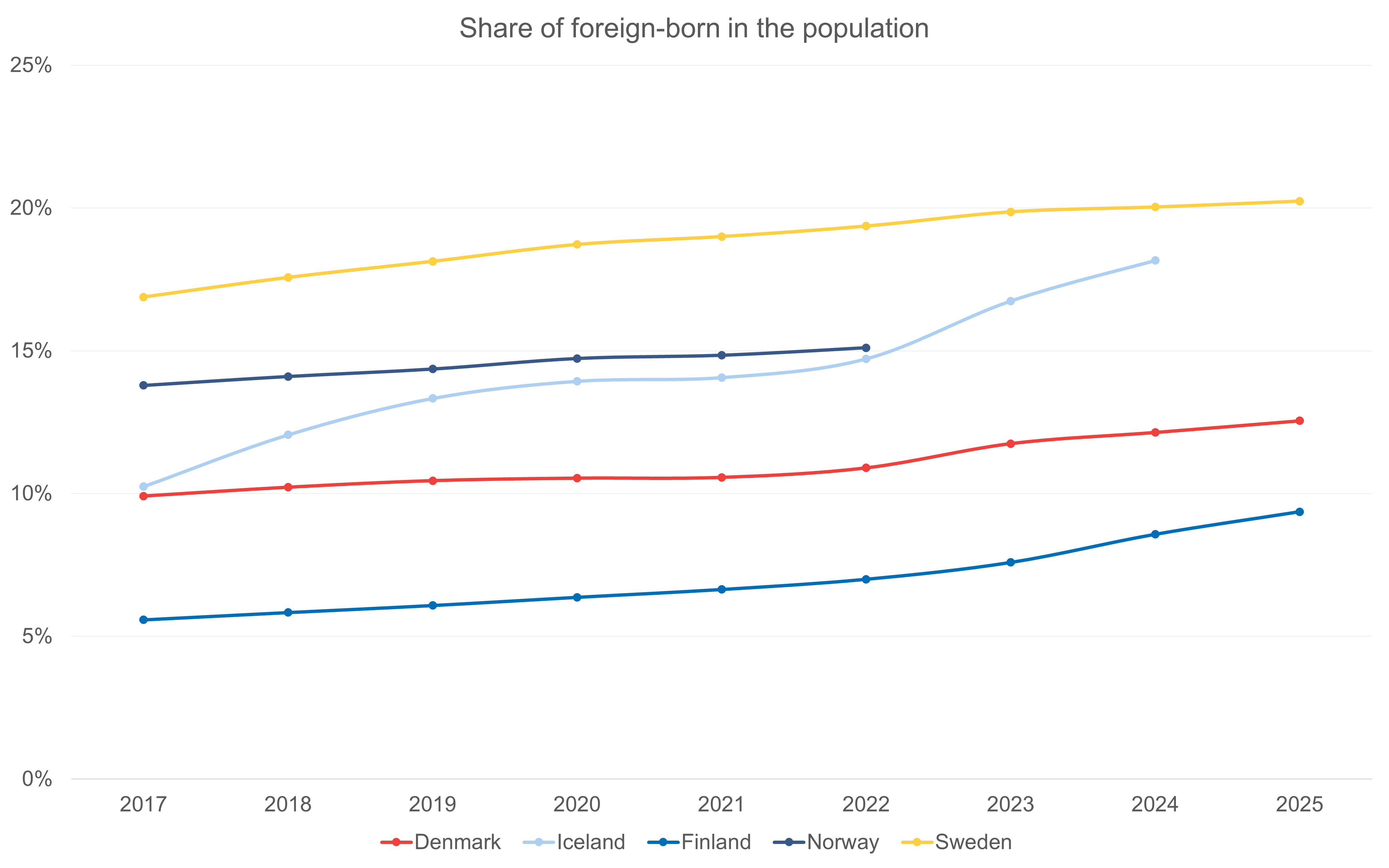
The foreign-born population [1] has been increasing in the Nordic countries since 2017, both in absolute and relative terms. The largest relative increase can be observed in Iceland, where the foreign-born population has increased by 8 percentage points as a share of the total population during the years 2017 to 2024. This is followed by Finland (3.8 percentage points), Sweden (3.4 percentage points) and Denmark (2.6 percentage points) during the years 2017 to 2025. [2]
By 2025, the foreign-born population accounted for the largest share of the total population in Sweden at 20 percent, followed by 18 percent in Iceland (2024).
Source: CITI03
Since 2022, Sweden has reported the smallest increase in foreign-born population by 0.9 percent. This can be compared with an increase of 1.6 percent in Denmark and 2.4 percent in Finland. In Iceland, the foreign-born population increased by 3.4 percent from 2022 to 2024 and has thus witnessed the largest increase.
Changes in country backgrounds
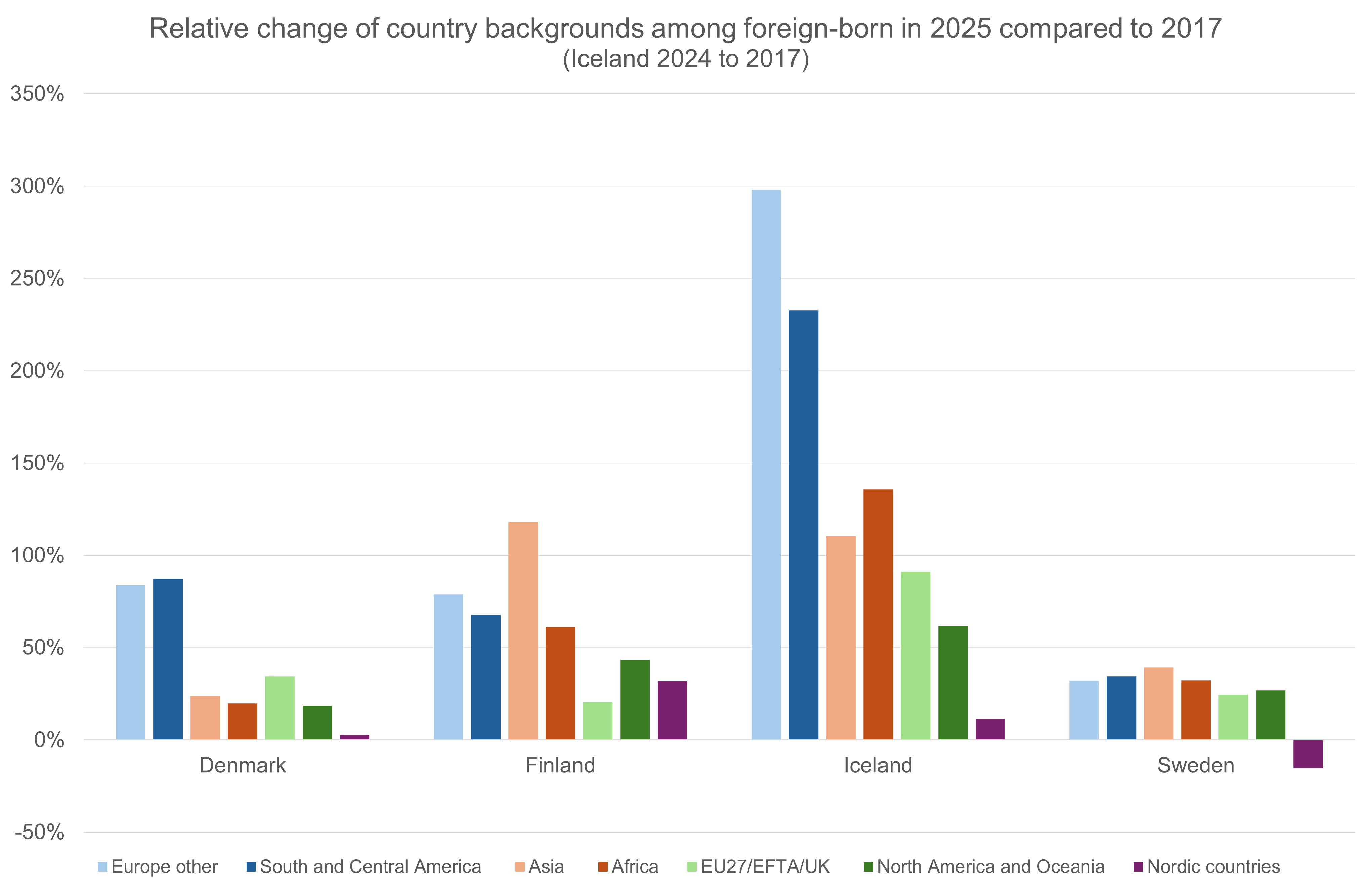
Even though all represented countries have witnessed a larger proportion of foreign-born individuals in their populations, some country background groups have increased more than others. In the graph below, the relative increase in country backgrounds is displayed from 2017 to 2025.
Note that ‘Europe other’ refers to countries in Europe (excluding the reporting country, Nordic countries, EU27 countries, EFTA countries and the UK).
Source: CITI03
Iceland - which reported the largest relative increase of foreign-born individuals from 2017 to 2024 – has consequently observed the largest relative increases in almost all population groups. Foreign-born individuals from ‘Europe other’ have increased by almost 300 percent in Iceland from 2017 to 2024, whereas individuals with a country background from South and Central America have increased by 230 percent. It is worth noting that the increases in Iceland are from low volumes. For example, the number of individuals with a country background from ‘Europe other’ have increased by about 5,000 individuals in Iceland, compared to more than 60,000 in Finland and Sweden respectively.
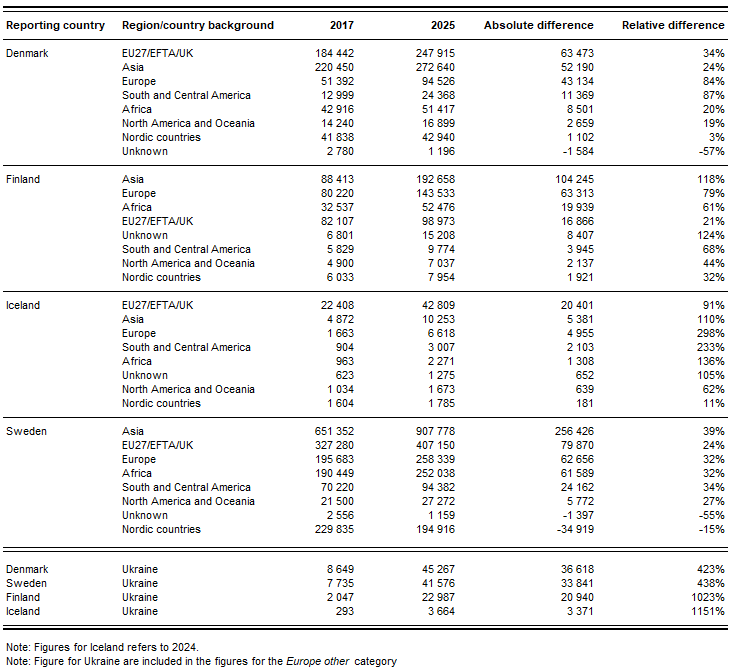
The largest increase in absolute terms is seen in Sweden for foreign-born with a background in Asia (approximately 250,000). During the same period, individuals with a country background in another Nordic country have decreased by 35,000 individuals in Sweden (see frequency table at the bottom of the article).
Ukrainian immigration
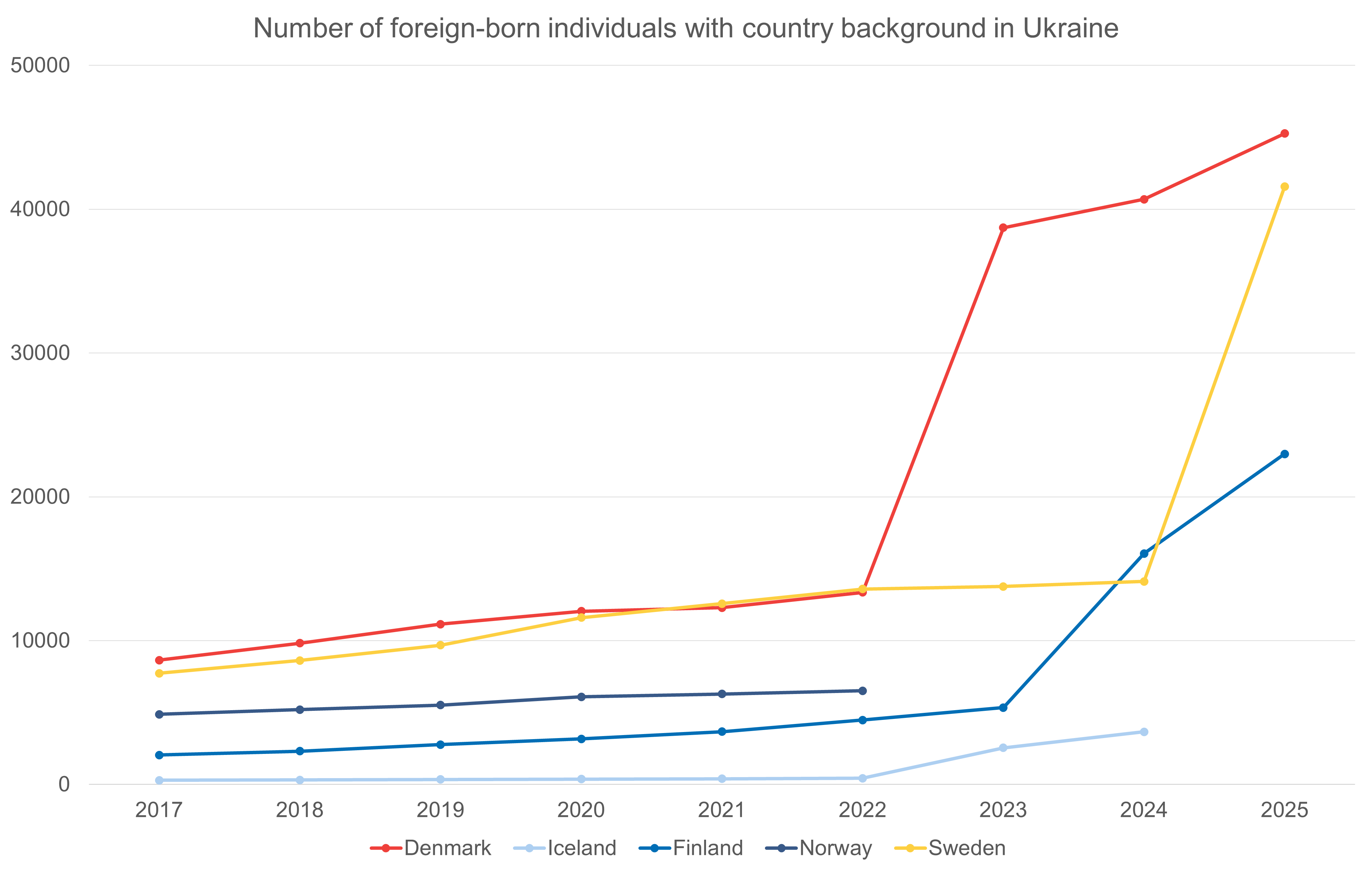
The increases in foreign-born with a background in ‘Europe other’ can to a large extent be attributed to immigration from Ukraine following Russia’s invasion in 2022. In the graph below, the number of foreign-born with a country background in Ukraine is displayed.
Source: CITI03
All Nordic countries have reported increases in individuals with a Ukrainian background since 2022. In absolute terms, the largest increase since 2022 can be seen in Denmark (32,000), followed by Sweden (28,000) and Finland (18,500).
Looking at the whole period from 2017 to 2025, the increases are slightly higher, and it is obvious that Ukrainians constitute a large share of the increase in the ‘Europe other’ category. In Denmark, Ukrainians constituted 85 percent of the increase in the ‘Europe other’ group, followed by Iceland (68 percent), Sweden (54 percent) and Finland (33 percent) during the period 2017-2025.
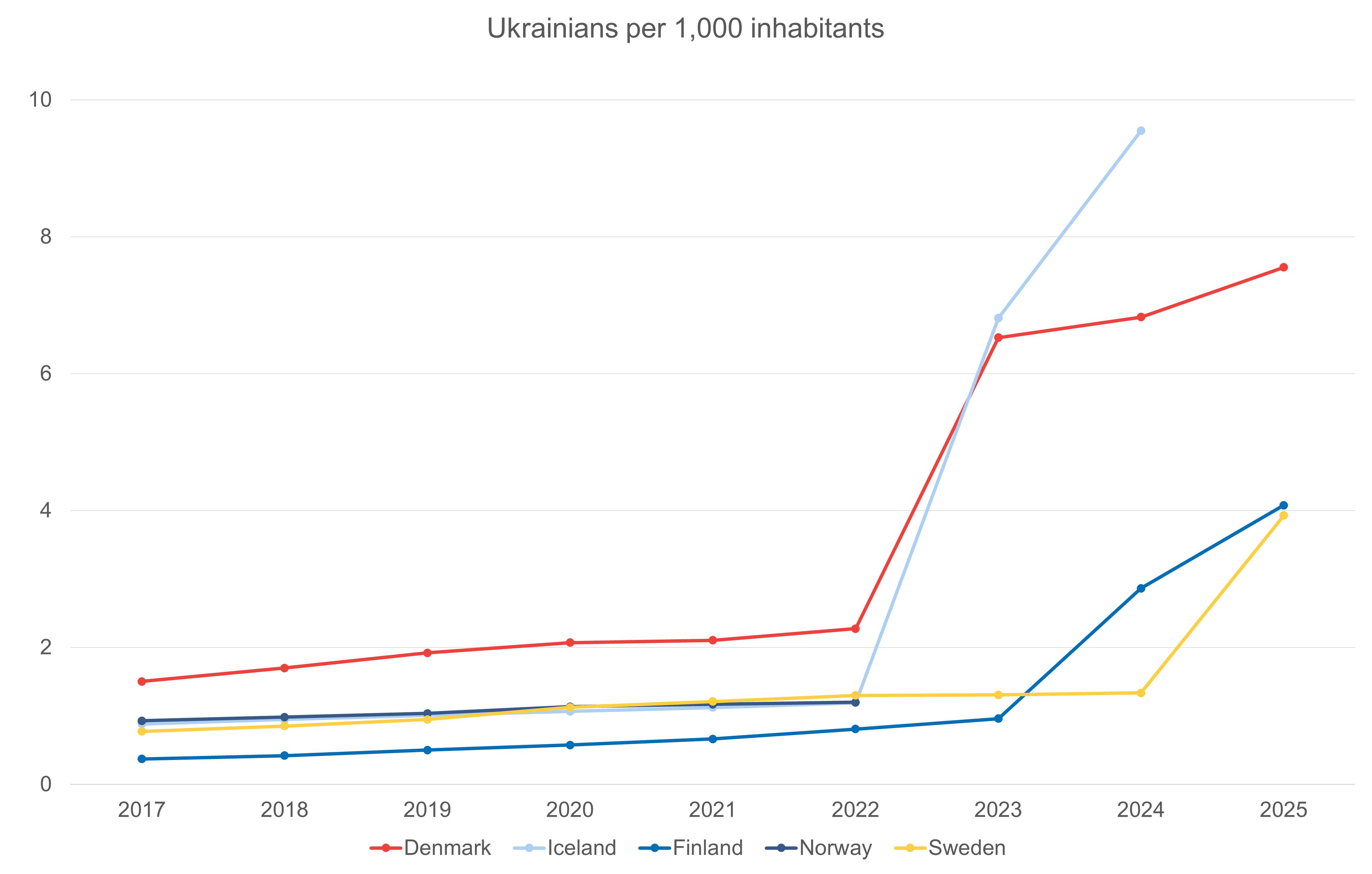
In the graph below, the number of Ukrainians per 1,000 inhabitants in each Nordic country are displayed to illustrate the relative increases of Ukrainians in relation to each country’s population size.
Source: CITI03
Since Russia’s invasion in 2022 up until 2025, the largest increase relative to the population size can be observed in Iceland [2], where Ukrainians have increased from 1.2 to 9.5 per 1,000 inhabitants. This is followed by Denmark (2.3 to 7.6), Finland (0.8 to 4.1) and Sweden (1.3 to 3.9).
In summary, the foreign-born population has increased in all Nordic countries during the past years. In relative terms, the largest increase can be observed in Iceland. This is especially true for the ‘Europe other’ group, which is primarily explained by an increase of foreign-born with a background in Ukraine. The other represented countries report large increases of foreign-born with a country background in Ukraine too. This can be depicted in the table below, which displays differences in regional backgrounds from 2017 to 2025.
Source: CITI03
[1] Foreign-born with two foreign-born parents (foreign-born with native-born adoptive parents are excluded).
[2] Figures for Iceland refer to 2024 since data is pending for 2025.